In this guide
Calculate AI automation ROI by comparing the value of a completed business task with the full cost of changing and running that task. Include implementation, integration, review, exceptions and maintenance. Report cash savings separately from the value of staff capacity released. Ten hours returned to a salaried team do not automatically remove ten hours from the payroll bill.
For an operations leader or SME founder, the decision is whether to fund one defined workflow, what the pilot must prove, and when to stop. A model subscription price or a generic productivity percentage cannot answer that decision.
This guide provides a worked business case, a sensitivity calculation and a downloadable reference calculator. Examples in this guide use fictional planning inputs; none is an AGI price, customer result or expected return.

Costs to include
- Implementation
- Integration
- Review
- Exceptions
- Maintenance
Hours returned to a salaried team reduce the payroll bill only when a payroll cost is actually removed.
Start with the decision and the accepted output
Choose a workflow boundary that ends in usable work. For inbound inquiry triage, that could mean a request classified, assigned to the correct owner and recorded with enough context to act. A generated category or a successful API response is only an intermediate output.
Measure the current process through that same endpoint. Include checking, correction and escalation time. Keep active staff minutes separate from elapsed turnaround: a request can wait overnight while requiring only a few minutes of work. Faster turnaround may matter commercially; count it separately from labor savings.
AWS’s process-cost guidance treats labor, technology and defects as separate baseline costs. Use your own observed inputs for those categories. Its illustrative cost ranges are not a price list or an estimate for your company.
Keep the population visible. If 400 requests arrive monthly but only 240 are eligible and actually use the new path, calculate the time effect on those 240. Retain the other 160 in the operational report. Do not multiply a pilot’s time reduction by every request unless that wider scope has been demonstrated.
What benefits should an AI automation business case count?
On smaller screens, scroll to compare all columns.
| Benefit | Evidence to collect | What it does not prove |
|---|---|---|
| Cash savings | A contractor bill, overtime payment or avoidable expense reduced because of the workflow | Allocated salary value alone is not cash released |
| Usable capacity | Net staff hours returned, the work they are reassigned to, and an explicit valuation assumption | Unused or fragmented time does not establish extra output or revenue |
| Quality or revenue effect | Comparable error/correction records or an evidenced change in contribution margin, with attribution limits | More drafts, contacts or meetings do not establish incremental profit |
Microsoft’s agent-impact guidance similarly warns against treating theoretical time savings as the whole value story. Its assisted-hours measures are useful indicators, but a capacity valuation still needs a business explanation.
For a conservative first case, leave revenue uplift at zero until you have evidence. If faster triage releases seller time, value that time once. Do not also assign an assumed sales uplift to those same hours and present both as independent benefits. For a separate revenue effect, use incremental contribution after associated delivery costs, with a defensible counterfactual.
What costs should an AI automation business case include?
One-time costs include discovery, process redesign, data preparation, integration, acceptance testing, internal staff time and training. Record when those costs occur. An external implementation quote is only part of the total if your team must clean data and review the pilot.
Recurring incremental costs include licenses, model/provider usage, retrieval or enrichment, infrastructure, monitoring, support and change work. Include failed attempts and reruns in consumption. Use incremental costs relative to the current process, with a separate allocated-cost view when shared resources matter.
Review and exception handling must appear somewhere, once. In the example below, all remaining active human work is included in the after-automation minutes. Dedicated maintenance labor belongs in recurring operating cost. Adding the same review minutes there again would understate the benefit; omitting them everywhere would overstate it.
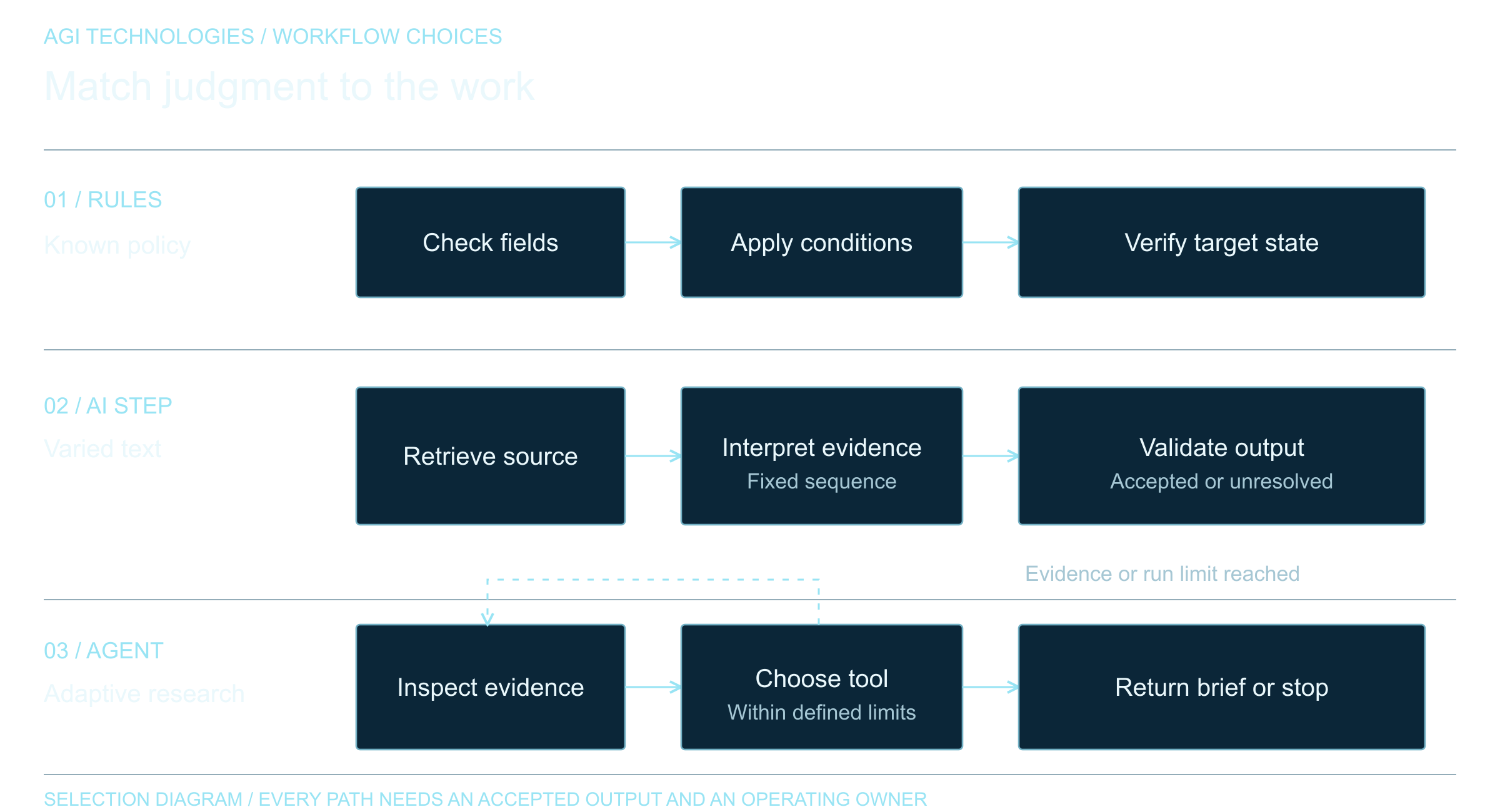
Match the architecture to the task before pricing it. Anthropic’s engineering guidance distinguishes predefined workflows from systems that choose their own tool path, and notes the cost and latency tradeoffs of added complexity. Compare rules, a fixed AI step and an agent against the same output. Our workflow-versus-agent guide addresses that architecture choice; this article addresses the resulting business case.
A worked example: the same workflow can look profitable and cash-negative
Example: inquiry triage. Assume 240 eligible requests use the proposed workflow each month. Current active work averages 18 minutes per request. After automation, the average is eight minutes, including review, correction and exceptions. Both paths must deliver the same accepted output; unresolved work cannot disappear from the accounting.
On smaller screens, scroll to compare all columns.
| Input | Assumption | Meaning |
|---|---|---|
| Monthly requests using the new path | 240 | Eligible, adopted scope; not all incoming demand |
| Active minutes before / after | 18 / 8 | After includes all remaining human handling |
| Loaded hourly value | EUR 40 | Assumed labor valuation |
| Monthly incremental operating cost | EUR 720 | EUR 600 fixed plus EUR 120 usage, including reruns |
| One-time implementation | EUR 4 800 | Illustrative combined internal and external cost |
| Capacity realization assumption | 50% | Half of the released hours can support identified useful work |
| Verified monthly cash savings | EUR 0 | No payroll, overtime or contractor expense assumed removed |
The net capacity released is 240 × (18 − 8) / 60 = 40 hours a month. At EUR 40 per hour, its full labor-equivalent value is EUR 1 600. Applying the stated 50% realization assumption values 20 usable hours at EUR 800. This is an opportunity-cost valuation; no cash is received.
Subtract EUR 720 of recurring cost: the base economic case returns EUR 80 net value a month. Simple implementation payback would be EUR 4 800 / EUR 80 = 60 months, if that benefit and cost remained constant. That is not a convincing 12-month payback case.
The cash view is less favorable: with no verified avoidable expense or incremental cash contribution, the project adds EUR 720 of monthly outlay plus EUR 4 800 upfront. It has no cash payback under these assumptions. A company can still choose it for quality or service reasons, but should name and evaluate those reasons and keep capacity value out of cash savings.
Use an explicit horizon for ROI
12-month valued benefit = 12 × EUR 800 = EUR 9 600
12-month incremental cost = EUR 4 800 + 12 × EUR 720 = EUR 13 440
Economic ROI = (9 600 − 13 440) / 13 440 × 100 ≈ −28.6%
This is a simple, undiscounted planning calculation with an immediate steady-state assumption. It excludes tax, financing, residual value and revenue uplift. It is not a net-present-value analysis. For an approval decision, use month-by-month adoption, costs and benefits; pilot and ramp-up months often differ from steady state.
Find the assumption that changes the decision
Holding the other inputs constant, monthly operating break-even requires EUR 720 / EUR 1 600 = 45% capacity realization. To recover implementation within 12 steady-state months, the monthly net benefit must reach EUR 400. That requires (EUR 720 + EUR 400) / EUR 1 600 = 70% realization.
On smaller screens, scroll to compare all columns.
| Realization assumption | Monthly net economic value | Simple implementation payback |
|---|---|---|
| 25% | −EUR 320 | No positive payback |
| 50% | EUR 80 | 60 months |
| 75% | EUR 480 | 10 months |
| 100% | EUR 880 | Approximately 5.5 months |
These are scenarios with no probability attached. “75%” needs a named use for 30 released hours, an owner and evidence that the time can be reassigned. If after-automation handling rises from eight to 13 minutes, only 20 hours are released. At 50% realization, valued benefit falls to EUR 400 and monthly net value becomes −EUR 320. Reviewing a few difficult cases can therefore matter more than reducing a small model bill.
Also test lower adoption, seasonal volume, extra support work and a delayed launch. For work whose quality threshold cannot be met, the ROI comparison is not valid, however attractive the spreadsheet looks. A cheaper wrong assignment is not the same deliverable.
Run a pilot that can reject the business case
Agree the acceptance rules before measuring speed. In inquiry triage, specify classification evidence, routing ownership, treatment of missing information and when a person must intervene. The AI workflow guardrails guide covers permissions and failure handling; the project deliverables reference shows how to record an acceptance brief.
Compare a representative set of requests under the current and proposed processes. Keep difficult inputs, interruptions and unresolved cases visible. Record active handling and elapsed turnaround separately, and avoid counting the same record again for each retry. Use observed accepted outputs and total review effort. An operator’s sense of how much faster the tool felt does not count as evidence.
Then replace the planning inputs: actual eligible/adopted volume, remaining human minutes, usage bills, maintenance effort and evidence of how released time was used. Keep measurement running after launch. AWS’s success-measurement guidance pairs financial baselines with operational quality and explicit termination decisions.
Before approval, name the maximum spend, required quality, acceptable review burden and payback or service objective. If the pilot cannot support the critical assumption, reduce the scope, change the design or stop. A failed business-case test can prevent a larger ineffective deployment. For help defining those criteria, review the AI Strategy and Readiness scope before commissioning a build.
Download and adapt the reference calculation
Download the AI automation ROI reference pack (ZIP). It contains editable JSON assumptions, a standard-library Python calculator, calculation checks, expected example outputs and a plain-text measurement brief. It sends no data and connects to no external service. Python is required to run the calculation; the formulas and inputs above are sufficient to reproduce it in a spreadsheet.
The included checks cover the arithmetic and boundary cases of the reference calculation only. The calculator keeps capacity and cash results separate, returns no payback for nonpositive monthly benefit, and refuses invalid percentages or negative costs. It does not detect double-counted benefits or decide whether a realization assumption is credible.
For a project discussion, bring one workflow, its accepted output, a current volume/time sample and the costs you can verify. AGI Technologies can scope a Systems Readiness Review around that decision. If the case holds and you want the workflow built, see our AI systems and automation services. For Clay specifically, use the implementation-budget guide to separate platform, provider and delivery costs before comparing proposals.
Reviewed by Andrii Gorbenko, founder of AGI Technologies