Sample system project deliverables
Inspect five files for one inquiry-to-CRM project: the brief, architecture, field dictionary, acceptance test cases and runbook. Use them to assess what a defined implementation should include.
- DefineBrief, architecture and field rules
- CheckSix expected acceptance cases
- HandoverOperating and recovery notes
Download and inspect
Five files, one reference project
Open any file without sharing an email address. All examples describe one fictional SaaS inquiry-to-owner system.
Project brief
Purpose, accepted input, responsibilities, dependencies, release gates and explicit scope boundaries.
reference-project-brief.txt
Download the briefSystem map
The full path, a log of every processed request, the review queue and the recovery steps for failed writes.
capture-to-owner-map.png
Download the architecture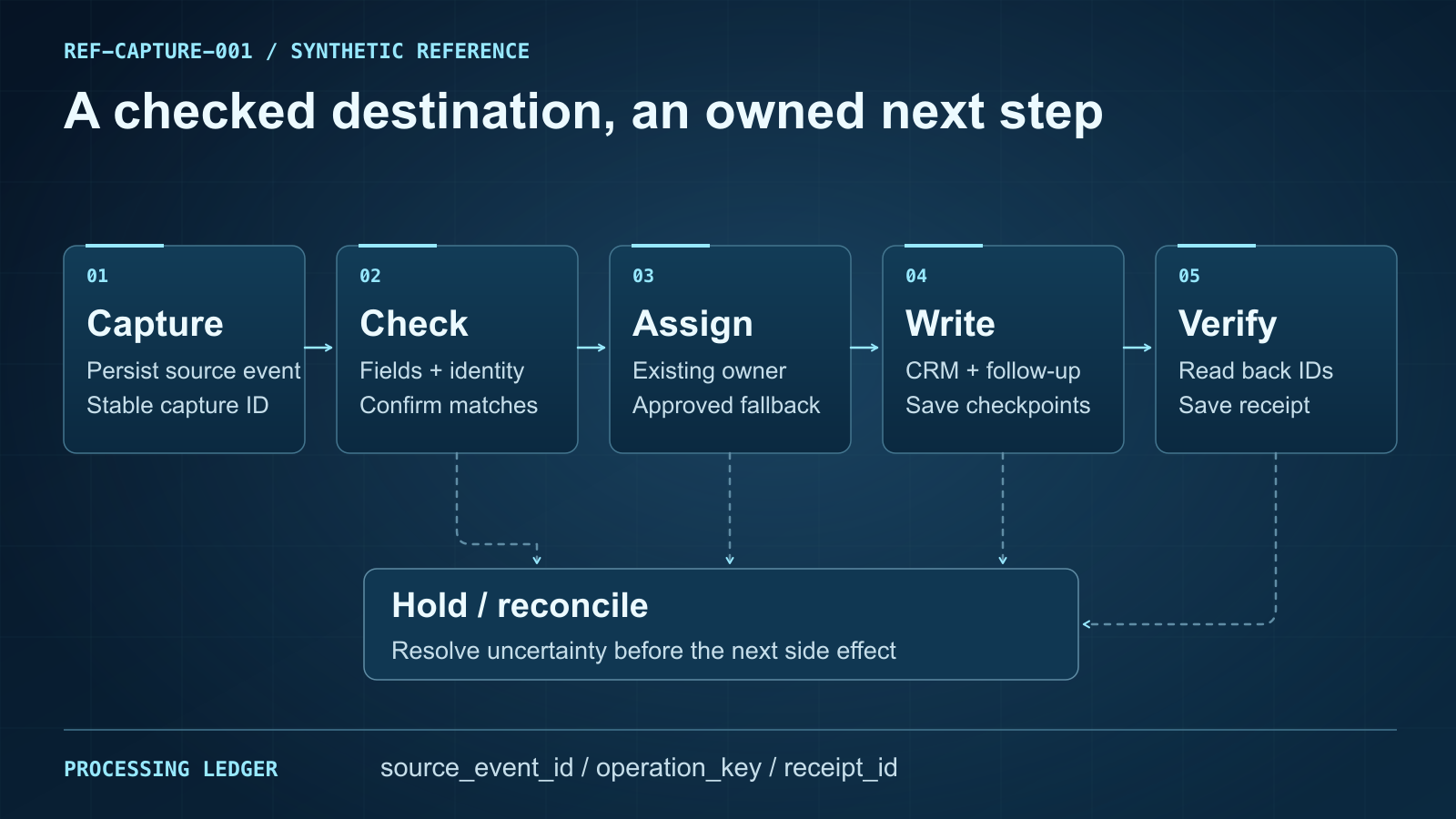
Field dictionary
Types, source ownership, permitted updates, examples and validation rules for the reference contract.
reference-field-dictionary.csv
Download the field dictionarySix acceptance test cases
New inquiry, repeated event, existing customer, invalid email, ambiguous identity and unknown write outcome. Includes input and expected destination state.
reference-acceptance-fixtures.csv
Download the fixture matrixHandover runbook
Monitoring, review ownership, reconciliation, controlled replay and change approval. Includes a release checklist.
reference-handover-runbook.txt
Download the runbookThe project boundary
One inquiry should reach an accountable next step
Use this synthetic reference for planning and review. Check every assumption against your own systems before a live build. For republication or redistribution, contact andrii@agitechnologies.io.
This vendor-neutral reference models a founder-led B2B SaaS team. A real build must map these application fields and rules to its actual forms, CRM and automation tools.
Inquiry-to-owner infrastructure
Accept a valid demo request, resolve the account and contact, preserve an existing customer owner, and create the agreed follow-up task. Hold invalid or ambiguous records with a visible reason.
- Input
- One versioned demo request
- Expected complete state
- Linked account and contact, named owner, follow-up task and receipt
- Outside this reference
- Marketing enrollment, lead sourcing and revenue forecasting
A worked record
From inquiry to expected CRM state
Test case A01 is a valid new inquiry that should be accepted. These are its expected values.
A request with a stable identity
The source submission ID stays stable across delivery attempts. The email and company domain are fictional examples.
- capture_id
- CAP-1001
- source_event_id
- SRC-1001
- work_email
- alex@nova.example
- company_domain
- nova.example
- inquiry_type
- demo_requested
An owner can act on the inquiry
The complete receipt requires a destination readback: linked records, the agreed owner and exactly one follow-up task for this capture.
- processing_status
- COMPLETE
- crm_account_id
- ACC-201
- crm_contact_id
- CON-301
- owner_id
- OWN-02
- followup_task_id
- TSK-401
Full system map
Follow the inquiry through each decision
The success path ends with checked destination records. Invalid input, uncertain matching and uncertain writes have separate routes.

- CheckPayload, identity and relationship
- AssignExisting owner or agreed fallback
- VerifyRecord, task and processing receipt
Acceptance expectations
Success and failure both need a defined state
The CSV carries the full input, existing records and checks. Before a production release, run these test cases in the chosen environment and check the destination records.
| Fixture | Input condition | Expected handling | Required check |
|---|---|---|---|
| A01 | New valid inquiry | COMPLETE | One account, contact association, owner and follow-up task; saved receipt |
| A02 | Previously completed source event | SUPPRESSED_REPEAT | Reference the original receipt; create no extra record or task |
| A03 | Existing customer account | COMPLETE | Preserve customer status and OWN-01; one task for the new inquiry |
| A04 | Invalid email value | VALIDATION_REVIEW | No CRM write; a review item explains the rejected field |
| A05 | Two plausible account matches | IDENTITY_REVIEW | No CRM write; resolve identity before a controlled replay |
| A06 | Write request times out | PENDING_RECONCILIATION | Record outcome as unknown; confirm destination state before any repeat write |
Operating decisions
A delivered form is only the start of the path
An accepted capture means the submission was persisted. COMPLETE means the required destination state was checked.
Use the source event ID to suppress repeated delivery, and record a separate operation key for each external side effect. A key is a design requirement: implement and test it in each build.
An uncertain match or missing active owner goes to review before CRM changes. A timeout after a write is different: the write might have committed. Reconcile the destination and saved operation state before deciding whether a replay is safe.
The approved inquiry purpose and captured permissions stay separate from marketing eligibility. The reference does not enroll contacts in campaigns or treat a form submission as a qualified opportunity.
Technical references
The recovery rules have a clear basis
The workflow is AGI Technologies' reference design. The references support its retry distinction and use of documentation domains.
- IETF RFC 9110, section 9.2.2
HTTP retry guidance distinguishes repeat-safe semantics from uncertain writes. The reference requires reconciliation before retrying an unconfirmed create action.
- IANA reserved domains
Reserved documentation domains keep every example fictional.
Apply it to a defined scope
Choose the service for your system boundary
Use the reference to describe the inputs, tools, operating model and failure case that your project needs to address.
Define the first complete path
For founder-led, first sales-team or trial-led SaaS requirements, scope capture, identity, CRM, owned actions and handover together.
Review startup infrastructureRepair CRM and RevOps handoffs
For an existing HubSpot system, review lifecycle definitions, record associations, routing and integrations against the way the team works.
Review HubSpot and RevOps servicesConnect the inquiry handoff
For a team with an existing website and stack, connect forms, CRM, automation and measurement with defined field ownership and validation checks.
Review martech infrastructureScope the next step
Define your project's input and terminal state
Share the current source, destination tools, decision owner and the failure you need to prevent. The reference pack can help describe the scope before discussing implementation.