In this guide: decisions, examples and worksheets
Clay implementation cost has four parts: the project build, software subscriptions, metered usage and ongoing operation. A subscription price answers only one of those questions. To budget the whole system, define the business output, the destination and the person responsible for using and maintaining it.
A researched account list, a controlled HubSpot enrichment workflow and a maintained signal-monitoring system require different work. Compare proposals against the same deliverable and commitment period. Include the responsibilities your team keeps after handover.
This guide combines dated Clay subscription references with an implementation budget method and an editable quote worksheet. Software prices are separate from the implementation fee. Examples in this guide use fictional companies and numbers.
A single proposal may combine all four costs. Establish the required outcome first, then identify the build fee, tool commitments, usage allowance and operating responsibility. Each line needs an owner and a basis for the estimate.

What do published Clay prices tell you?
Clay’s subscription price is one input to an implementation budget. The monthly starting references below come from Clay’s plans and billing guide, checked on 12 October 2026. They cover software access. Implementation, training and ongoing operation are separate costs.
On smaller screens, scroll to compare all columns.
| Clay software plan | Billing-guide monthly starting reference | Budget treatment |
|---|---|---|
| Clay Launch | US$185/month | Software subscription. Confirm the selected allowance and billing terms. |
| Clay Growth | US$495/month | Software subscription. Scope the implementation and operating responsibilities separately. |
Clay displays lower effective monthly amounts under annual billing. A discounted monthly equivalent is different from a cancellable monthly payment. Its pricing card and FAQ also displayed different Launch credit allocations on 12 October 2026. Confirm the selected allowance in the actual workspace or order before budgeting. Clay pricing, plans and billing.
Compare implementation quotes against a written scope: the accepted deliverable, included setup and data repair, destination checks, training, handover and ongoing ownership. Ask for a contracted delivery date and clearly stated exclusions. A headline fee alone does not show whether those requirements are covered.
The useful buying question is therefore: what does this fee deliver, what other bills remain, and what will our team still need to do? Dividing an implementation fee by its timeline does not turn it into a comparable managed-service rate.
What does a Clay implementation cost?
1. Discovery and implementation
The project fee covers agreed work such as translating the ICP into usable criteria, inspecting source data, configuring research, mapping fields and testing the destination. Cleanup, training and documentation may be included or separately scoped.
Ask for a deliverable. A tool-list request such as “Connect Clay and HubSpot” leaves the CRM objects, identity rules, allowed updates, protected fields and exception handling undefined. State whether the engagement repairs existing data or assumes that data is ready.
2. Software subscriptions
List the required Clay plan, HubSpot capabilities and external providers. Separate existing commitments from incremental purchases. A trial demonstration does not establish the continuing plan entitlement, and a legacy Clay workspace may have different terms. Clay plans and billing, legacy plans.
Decide who owns each account and who pays its invoices. Access through a provider's shared account can create a different handover problem from a build delivered into your own workspace.
3. Metered usage
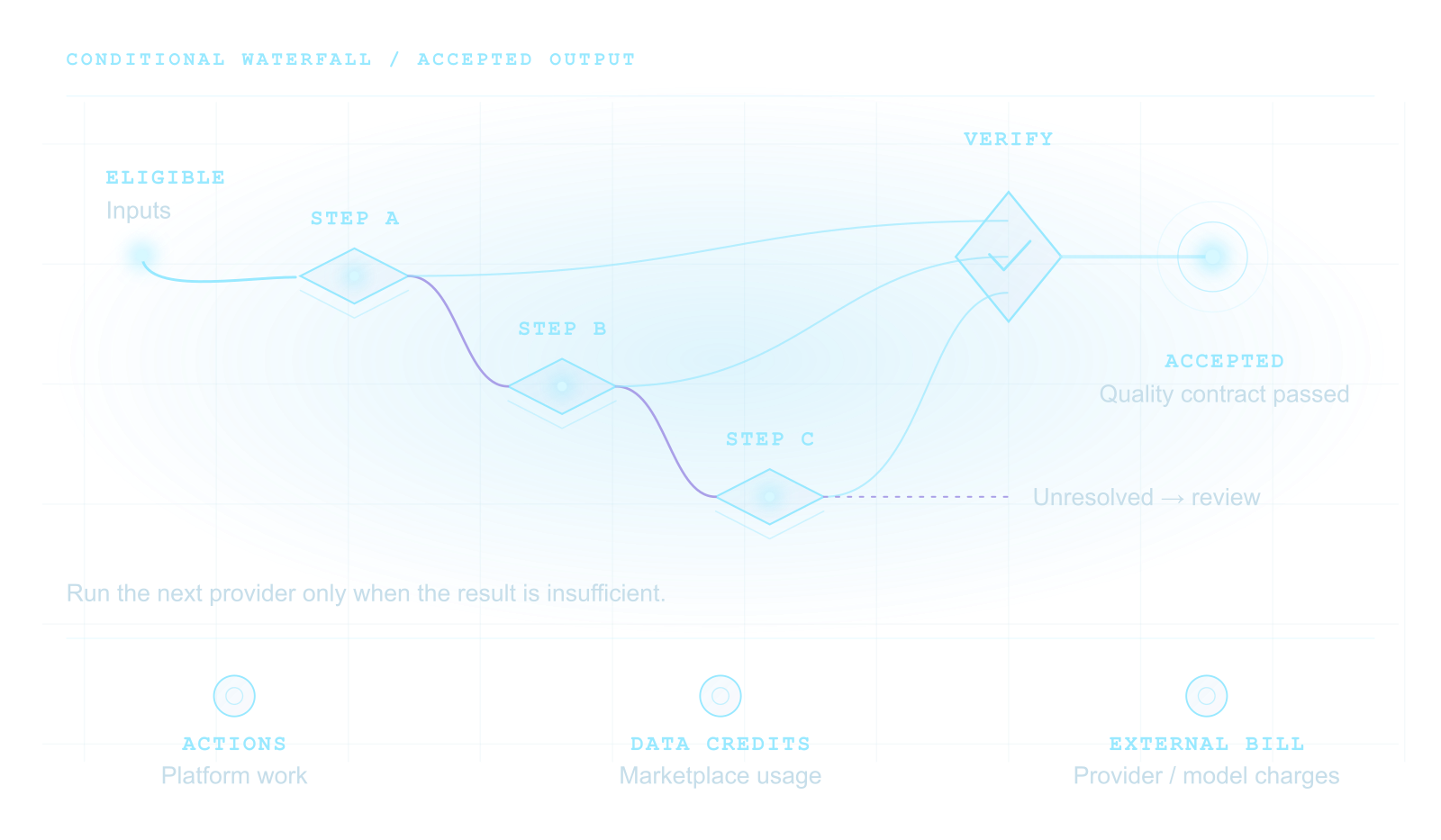
Clay distinguishes Actions, which meter platform work, from Data Credits, which pay for marketplace data or AI. Using an external provider key can move its charge outside Clay while Actions remain. Check that provider's invoice as a separate ledger. Actions and Data Credits.
Subtract usage already included in the subscription before adding incremental charges. Do not treat a monthly allowance as both an included benefit and a second full-cost line. Ask which configured operations consume each meter and what happens when capacity is reached.
4. Operation and change
Assign the review of uncertain results, failure handling and changes to sources or business rules. Separate maintenance of the agreed build from adding a new market, signal, destination or campaign.
A recurring fee should name recurring responsibilities. A one-time reviewed export may need no ongoing operator. A system that affects CRM records or sales priorities needs an owner, whether internal or external.
Which requirements change the implementation quote?
Use this scope matrix before requesting proposals. Record count becomes meaningful after these decisions are clear.
On smaller screens, scroll to compare all columns.
| Requirement | Specify in the brief | Why it changes the work |
|---|---|---|
| Business output | Reviewed list, enriched record, account brief or owned task | Each deliverable has a different acceptance test. |
| Identity | Record IDs, domains, source consistency and known duplicates | Uncertain identity requires a hold or review path. |
| CRM model | Objects, associations, writable and protected properties | Relationships and field policies add decisions beyond enrichment. |
| Research | Exact questions, permitted sources and unknown handling | Sourced AI research needs evidence and review criteria. |
| Eligibility and cadence | Who enters the workflow and when it repeats | Total database size does not describe required usage. |
| Integration route | Table actions, Audiences or a custom API connection | The route determines what can be read or written. |
| Ownership | Review, maintenance, training and change approval | Handover must fit the team's continuing capacity. |
A small cohort with ambiguous matching and complex associations can need more design work than a larger, clean research export. Avoid buying a record allowance before agreeing what each accepted record must contain.
Name exclusions. Sending campaigns, deliverability work, reply handling and sales execution should have an explicit owner if required. An enrichment implementation does not automatically include them.
Build a budget for the same commitment period
Use one period, such as the first three months, to compare the cash commitments behind competing quotes. For a budget horizon of H months:
Cash budget = one-time build and cleanup + subscription cash payable during H + expected usage not already included + external-operation cash payable during H + separately approved change work.
Use the actual billing terms. If a contract requires annual prepayment, include the cash payable during your chosen period, even when its effective monthly amount looks lower. Keep currencies separate until a dated conversion basis is agreed; record tax treatment as quoted.
Track internal capacity beside the cash budget: exception review, sales adoption, administration and maintenance. Record a responsible role and an estimated time requirement. Convert time into cost only with your organization's agreed basis. Time apparently saved by research automation is not automatically payroll saving or additional revenue.
Do not count an already-owned subscription as a new purchase in the incremental cash comparison. Show it in a separate full operating-cost view if needed. This makes “Can we afford the next step?” and “What does this system cost to run?” answerable without mixing their accounting boundaries.
A worked example: budget only the eligible rows
Capacity model. A company supplies 1 000 account records. Its agreed rules make 250 eligible for two data enrichments and one HubSpot update during the next cycle. The remaining records are held or excluded before those operations.
Assume each eligible record produces two chargeable enrichment results and one chargeable CRM export. Exclude sourcing charges, AI research, retries, additional lookups and other operations from this simplified example.
On smaller screens, scroll to compare all columns.
| Model input or calculation | Value |
|---|---|
| Supplied account records | 1 000 |
| Eligible records for this cycle | 250 |
| Chargeable operations assumed per eligible record | 3 |
| Planned Actions for the defined cycle | 250 × 3 = 750 |
| Same three operations on every supplied record | 1 000 × 3 = 3 000 |
The difference is a scope calculation. Data Credits still depend on the selected providers; cash cost depends on the workspace allowance and billing terms. The 250 eligible records are an assumed input for this example.
Clay documents formulas and filters as operations that do not consume Actions, while enrichments and CRM exports do. CSV download also consumes neither Actions nor Data Credits. Confirm the configured route before applying this model to a real workflow. Actions and Data Credits.
The procurement lesson is to ask for eligible records per cycle, the operations they require and the reason they repeat. A “10 000-row system” does not answer those questions. Measure a representative pilot before agreeing recurring capacity.
Budget HubSpot integration from the actual route
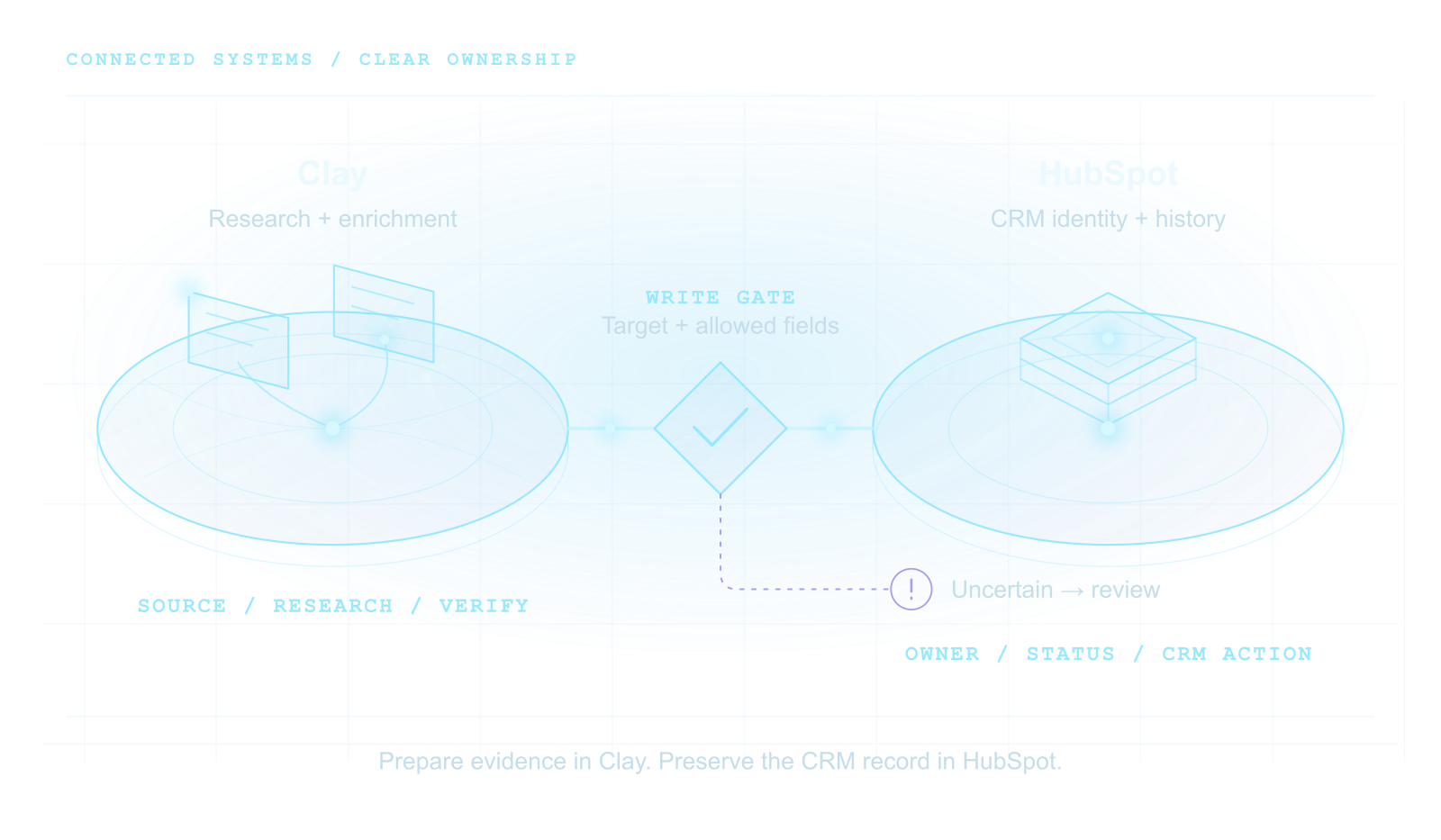
Clarify whether the proposal means a Clay table workflow or Clay Audiences. Current table documentation supports importing, looking up, creating and updating HubSpot objects. Updates require a HubSpot object ID; ignoring incoming blanks is a documented option. Clay HubSpot integration.
Current Audiences documentation describes HubSpot as import-only. It does not write enriched Audience data or segment membership back to HubSpot; Salesforce is the documented write-back destination. A proposed HubSpot write loop must name the route performing its writes. Clay Audiences.
Include matching and destination checks in the implementation scope. HubSpot says API-created companies, including those created through third-party sync apps, are not automatically deduplicated by domain. A domain alone is not a blanket guarantee against duplicate creation. HubSpot deduplication.
Check what HubSpot already supplies. Standard data enrichment does not consume HubSpot Credits, while smart properties do. Verify the selected features, eligibility, permissions and subscription before adding a credit allowance or recommending an upgrade. HubSpot data enrichment.
Use the Clay and HubSpot integration guide for setup decisions. The Clay versus HubSpot guide helps decide which work belongs in each tool.
What should a pilot establish before you approve rollout?
Choose a permission-appropriate sample containing ordinary records and the difficult cases the intended workflow must handle. Agree on acceptance rules before running it. An operationally useful result can be a smaller scope or a decision to keep the work in HubSpot.
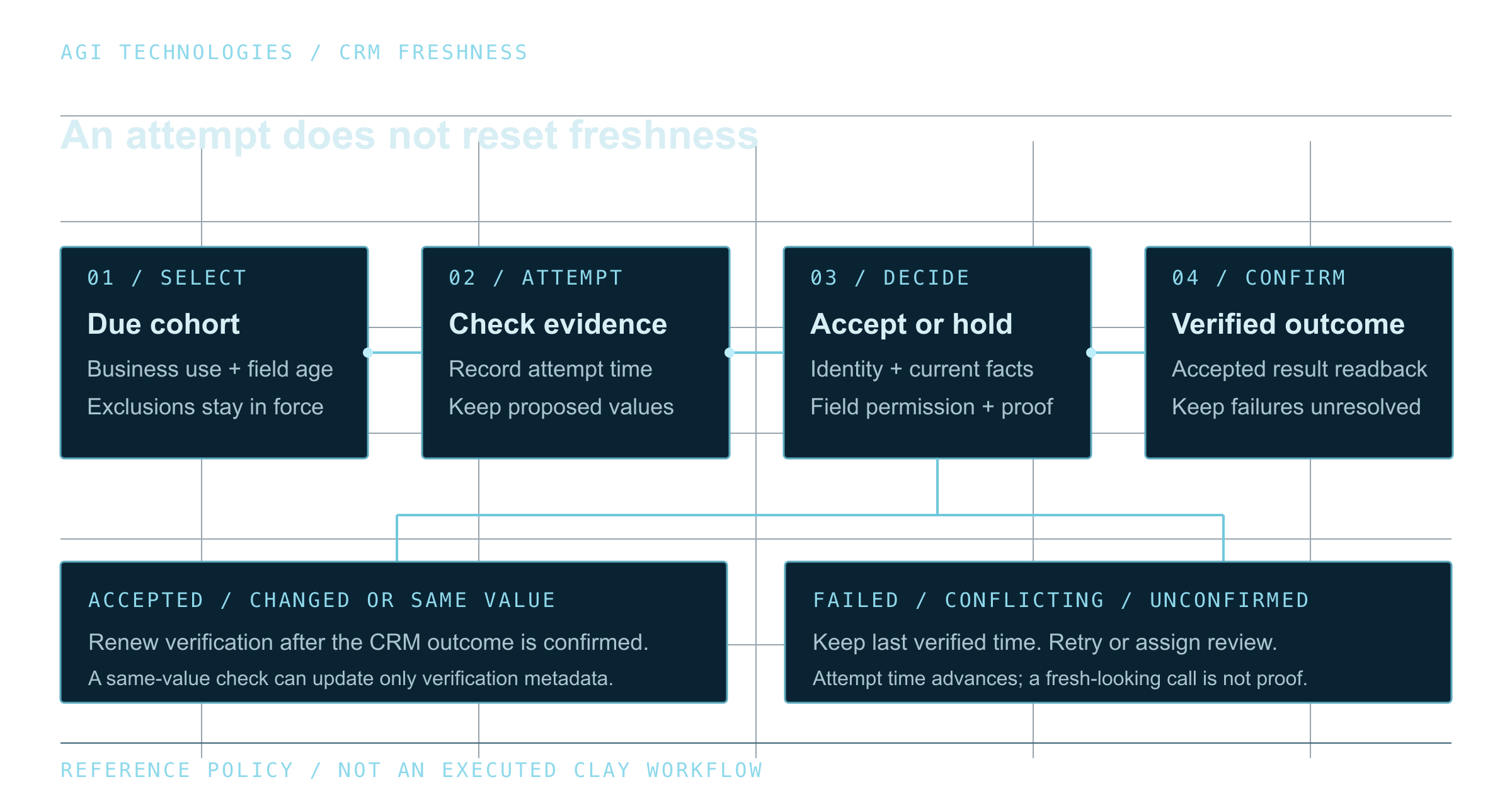
Record the accepted output, actual usage, unresolved exceptions, destination checks and review effort. An AI result that requires review can still have incurred a charge; count only accepted values as business results. Track Actions, Data Credits and external provider invoices separately.
For variable-priced AI models, the displayed estimate can differ from the final charge. Clay documents an upfront credit estimate followed by reconciliation against actual usage. Budget research from the model and prompt you will use. Clay AI pricing.
The cost per accepted record guide covers the operating calculation in detail. This buying decision needs an additional check: does the pilot demonstrate an output your team will use, with an exception load it can manage?
For example, an acceptance statement might say: “For eligible companies with one resolved HubSpot record ID, write only the agreed research fields, retain their evidence and verification date, preserve protected properties, and hold ambiguous matches.” That is a proposed requirement; confirm which parts the configured connector enforces and which need review.
Should you hire a Clay agency or build in-house?
On smaller screens, scroll to compare all columns.
| Delivery model | Appropriate when | Responsibility to resolve |
|---|---|---|
| Internal build | A named operator can research, configure and maintain the workflow. | Time for design, destination checks and exception review, beyond the software invoice. |
| Scoped implementation and handover | The team can operate a documented system but needs help designing and launching it. | Acceptance, ownership, training and the maintenance boundary after delivery. |
| Maintained service | Recurring research, monitoring or CRM work needs an external owner. | Named recurring outputs, review cadence, limits and approval of further work. |
Choose a managed service for specified ongoing work. Ask who handles provider changes, failed writes and a change to the ICP. “Optimization” needs a concrete review or deliverable before it belongs in a monthly proposal.
For handover, request the field dictionary, source and prompt definitions, operating instructions, exception ownership and relevant workspace access. Include a process for disabling the workflow and recovering permitted changes. A walkthrough video can support those materials; it does not replace them.
Compare quotes with the editable worksheet
Download the Clay implementation quote-comparison worksheet
The CSV contains blank columns for two providers, scope prompts, budget treatment, acceptance, ownership and continuing responsibilities. It contains no prefilled fees or forecast results.
Complete your requirement first. Then add each provider's exact statement, source and term date. Mark unanswered items as unresolved. A lower headline fee may cover a table build while another includes data repair, CRM integration and team training.
Before approving a proposal, resolve five decisions: the accepted deliverable, included and excluded work, the cash commitment, the continuing owner and the response if acceptance fails. If any is unclear, narrow or clarify the scope before comparing totals.
Use the Systems Readiness Review for Clay and HubSpot when the starting requirements need inspection. The Clay implementation framework supports an internal brief. For an agreed build, review the implementation service and request a quote.
Product details come from the linked Clay and HubSpot pages as of 12 October 2026. Confirm current account terms before buying.
Reviewed by Andrii Gorbenko, founder of AGI Technologies